Abraham Van Calraet
(Dordrecht 1642 - Dordrecht 1722 )
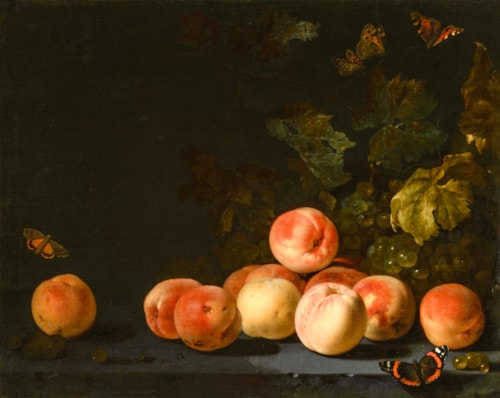
Still Life with Peaches
Abraham van Calraet (1642–1722) was a Dutch painter from the Golden Age, known for his still lifes. He was a pupil of Willem van Aelst and specialized in the precise and detailed depiction of everyday objects such as flowers, fruit, and insects. Van Calraet's work was praised for its technical precision and the use of subtle color nuances, as well as his ability to emphasize the transience of nature.
One of his signature works is this signed still life painted on panel, featuring peaches and a butterfly at ithe right. Van Calraet employed the glaze technique, layering multiple thin coats of paint to create depth and shine, particularly visible in the texture of the peaches. The soft skin and almost tangible volume of the fruit are meticulously rendered, evoking a sense of realism.
The peaches are carefully presented, with rich color variations highlighting the ripeness and delicate texture of the fruit. The round shapes of the peaches are enhanced by a skillful application of light and shadow, giving them a vivid, three-dimensional appearance.
The butterfly in the painting is depicted with great care and attention to detail, it not only adds aesthetic value to the composition but also carries symbolic meaning, common in Dutch still lifes of the seventeenth century. The butterfly is often associated with transience and the fleeting nature of life, a theme central to many still life paintings of the time.
In this work, the artistic and symbolic elements come together: the peaches represent the beauty and richness of nature, while the butterfly evokes reminders of the transience of all living things. The painting, therefore, is not just a depiction of nature but a reflection on the temporality of life, which was a significant theme in the art of the Golden Age.
Signed with the monogram (AvC) below left
Oil on panel, 40.5 x 50 cm
+32 (0)478 38 18 29



RELATED WORKS
YOU MAY ALSO LIKE