Master of the Eeghen Drawing Book, ca 1630
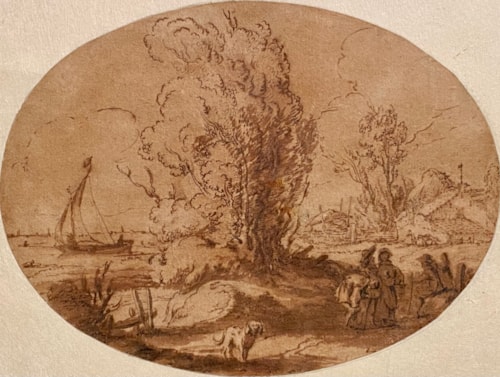
Landscape with a tree, travellers with a dog and a Schip beyond
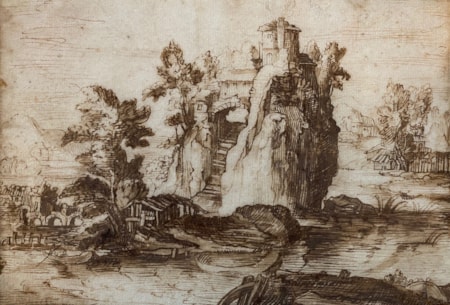
The name “The Master of the Van Eeghen Drawing Book” was introduced by the art historian Erik Löffler in 2004 to designate an anonymous draughtsman whose work is preserved in a Dutch private collection formerly belonging to the Van Eeghen family. The corpus consists of a coherent group of landscape drawings that display a distinctive artistic personality. Before Löffler’s study, several of these sheets had traditionally been attributed to Jacob van Geel, an understandable association given the stylistic affinities between the two artists. Both favour imaginary landscapes populated with expressive, gnarled trees, rocky outcrops, and a poetic, almost visionary atmosphere. Yet closer analysis has shown that the Van Eeghen master’s drawings form a separate and consistent oeuvre, distinct in both chronology and execution.
The artist’s style is characterised by precise penwork, subtle washes, and a refined sense of rhythm within the composition. His landscapes are not topographical but constructed, often built from diagonals, stepped rock formations, and clusters of trees that guide the viewer’s eye through the scene. The trees themselves—knotty, asymmetrical, and rendered with a calligraphic elegance—are among the most recognisable features of his hand. These qualities place the master within the broader tradition of early seventeenth‑century Dutch landscape drawing, alongside figures such as Van Geel, Hercules Seghers, and Allaert van Everdingen, yet his work retains a distinct voice.
The drawings attributed to the Master of the Van Eeghen Drawing Book are generally dated to circa 1630–1650, a period in which the Dutch Republic saw a flourishing of landscape art that blended observation, imagination, and classical ideals. Although the artist’s identity remains unknown, his work suggests a draughtsman active in the Northern Netherlands, possibly in Amsterdam or Utrecht, where interest in refined, imaginative landscape studies was particularly strong.
This group of drawings is significant for its subtlety and poetic sensibility. It reveals an artist who combined technical finesse with a highly personal vision of the natural world. The rediscovery and reclassification of the oeuvre by Löffler has brought renewed attention to this intriguing master, whose work stands as a testament to the richness and diversity of seventeenth‑century Dutch draftsmanship.
Brown ink and Washes, oval 13 x 17.3 cm
+32 (0)478 38 18 29
RELATED WORKS
YOU MAY ALSO LIKE