Adriaen Van Stalbempt
(Antwerp 1580 - Antwerp 1662 )
Travellers in a Landscape
Adriaen van Stalbemt (Antwerp, 1580–1662) was a Flemish Baroque painter and printmaker, best known for his finely detailed landscapes that often included religious, mythological, or allegorical scenes. He was also a gifted figure painter who was regularly invited to paint the characters in compositions by fellow painters.
After the Fall of Antwerp in 1585, his family moved to Middelburg for religious reasons. There, he likely received his artistic training. When the Twelve Years’ Truce began in 1609, he returned to Antwerp and became a master in the Guild of Saint Luke that same year. His marriage to Barbara Verdelft, the daughter of an art dealer, helped him establish a successful career, allowing the couple to purchase a house on the Meir, one of Antwerp’s most fashionable streets.
In 1618–1619, van Stalbemt served as dean of the guild, where he helped restore privileges to the chamber of rhetoric known as De Violieren. He established himself as a landscape painter, but was also a skilled painter of people and animals. He worked on commission for the art dealer Peter Goetkint II, for whom he made cabinet paintings, i.e. small paintings on copper that were built into cabinets. He also made paintings for the Antwerp art dealer Chrysostomos van Immerseel.
In 1633, he spent about ten months in London. Cornelis de Bie reported that King Charles I of England had invited the artist to England. During his stay, he painted two landscapes of Greenwich featuring King Charles I and Queen Henrietta Maria, both still part of the Royal Collection today. He must have enjoyed a considerable reputation, for it is hardly likely that otherwise King Charles I would have called him to England.
Van Stalbemt was a versatile artist, skilled both as a landscape painter and a figure painter, often collaborating with other artists such as Pieter Brueghel the Younger. His style shows the influence of Jan Brueghel the Elder, Jan Brueghel the Younger, Hendrick van Balen, Paul Bril, and Adam Elsheimer. Alongside Abraham Govaerts, he is considered one of the best followers of Jan Brueghel the Elder. Only a small number of his works are dated, which makes it difficult to establish a chronology. He also made etchings. A series of landscape prints by his hand depict a coastal seascape with ships, a watermill, a windmill, ruins, and a castle on a mountain.
He continued painting until his old age (80) and although he had converted back to Catholicism when he married, he returned to Protestantism shortly before his death in 1662.
Van Stalbemt’s landscapes are often described as eclectic, reflecting the influence of several artists. His paintings share the pastoral calm and fine detail of Jan Brueghel the Elder’s work, though his palette often includes light yellow tones for the foliage and architecture.
Painted in oil, the work is modest in size, typical of the small-scale cabinet landscapes popular during the Dutch Golden Age. Most Dutch landscapes were relatively small. The Dutch tended to make smaller paintings for smaller houses. During this period, landscape painting became an independent genre, no longer just a backdrop for biblical or mythological scenes. Artists began to treat the landscape itself as a subject of beauty and contemplation.
Van Stalbemt’s landscapes are peaceful and poetic, focusing on harmony rather than drama. The balance of figures, architecture, and nature reflects the Baroque fascination with order, light, and the quiet splendour of the natural world.
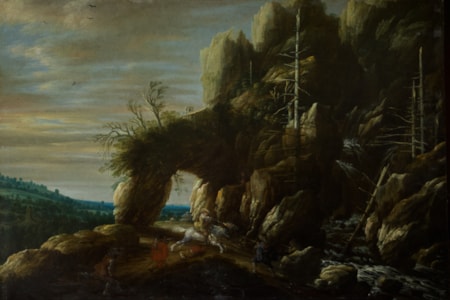
The scene is situated on the edge of a forest. Two riders are preparing to leave again. One, sitting on the horse, chases the other. A servant helps the man on the left to harness his horse. Judging by the look on his face, it's not happening fast enough. Judging by the outfit, they look like hunters or travellers. Their horses are also loaded with bags. In the background we see two wooden huts and another working figure. The mountain landscape in the distance is painted with such precision that we can still see small trees.
The composition is constructed in such a way that our eye is drawn into the scene. The trees on the side provide a passage to the mountain landscape in the distance. Through the use of color, van Stalbemt creates depth. The closer to the viewer, the brighter colors. In the distance they are rather blurred and flow into each other. In the right foreground we have a great contrast with light and dark. The grass is covered with a black shadow while the leaves are beautifully illuminated.
This painting captures van Stalbemt’s ability to combine realism and imagination within a tranquil natural setting. Influenced by the detailed style of Brueghel yet marked by his own softer palette, this landscape invites the viewer into a world of quiet reflection where nature, light, and human presence exist in perfect balance.
Signed on the trunk of a tree
Oil on copper, 27,5 x 40cm
+32 (0)478 38 18 29

RELATED WORKS
YOU MAY ALSO LIKE