Jan Boeckhorst
(Münster 1604 - Antwerp 1668 )
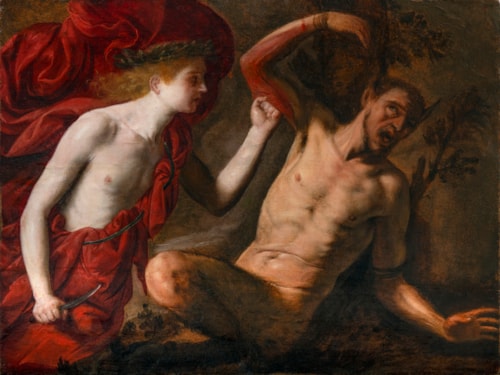
Apollo and Marsyas
Jan Boeckhorst originally from Münster, settled in Antwerp around 1620. He trained with Jacob Jordaens and later worked in the studio of Peter Paul Rubens during the 1630s. Twice he travelled to Italy, where he deepened his knowledge of classical art; alongside Rubens, the refined elegance of Anthony van Dyck left a lasting mark on his style. After Rubens’ death in 1640, Boeckhorst was entrusted with completing several of the master’s unfinished commissions.
As his career progressed, Boeckhorst increasingly developed his own artistic voice, producing monumental religious works as well as designs for tapestries. His particular fascination with the figure of Apollo is well documented: several modelli for a tapestry cycle on the god’s history survive. The best‑known example is the oil sketch Apollo and Python in the Museum of Fine Arts, Ghent (inv. 1904‑B).
The present work, executed on paper, clearly functions as a study or modello for a larger composition. Its stylistic affinities with the Ghent sketch, especially in the handling of form, movement, and dramatic tension, are unmistakable.
The subject derives from Ovid’s Metamorphoses (VI, 382–400). The satyr Marsyas challenges Apollo to a musical contest, agreeing that the victor may do with the loser as he pleases. When Apollo triumphs, he binds Marsyas to a tree and flays him alive, a myth that embodies themes of artistic rivalry, divine justice, and the peril of hubris.
This study reveals Boeckhorst’s command of expressive anatomy, dynamic composition, and mythological narrative, offering a vivid glimpse into the preparatory process behind his larger, more elaborate works.
oil on paper glued on panel, 44.5 x 55 cm
+32 (0)478 38 18 29
RELATED WORKS
YOU MAY ALSO LIKE