Flemish School 17th Century
( 1600 - 1699 )
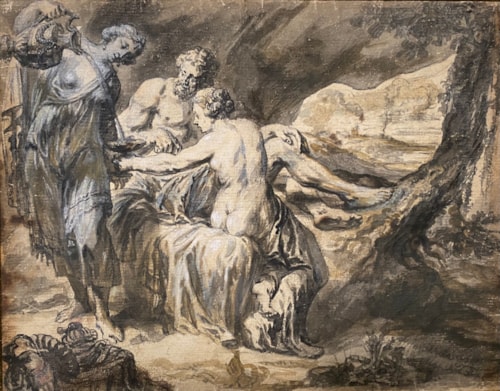
Lot and his Daughters
This refined drawing belongs to the Flemish School of the 17th century, a period in which artists combined the elegance of Italianate classicism with the lively narrative tradition of Antwerp. Draftsmanship played a central role in artistic training, and many painters produced highly finished studies that reveal both technical mastery and a sophisticated sense of composition. Drawings from this milieu are typically characterised by clear contours, graceful figures, and harmonious, balanced poses, reflecting the influence of Italian art and the idealisation of the human form.
The subject is taken from Genesis 19, where Lot flees to the mountains with his two daughters after the destruction of Sodom and Gomorrah. His wife, having looked back, has already been turned into a pillar of salt. Believing that no men remain with whom they might ensure the continuation of their family line, the daughters decide to intoxicate their father and lie with him on successive nights, without his knowledge.
In the seventeenth century, this episode was generally interpreted as a moral warning, illustrating the dangers of desperation, deception, and the collapse of social order, rather than as a justification for the daughters’ actions.
The present drawing reflects the refined, classicising tendencies of Flemish art of the period. The figures are idealised yet expressive, and the composition is carefully constructed to convey both intimacy and narrative clarity. Although such sheets often served as preparatory studies for larger works, they also possess an independent artistic value, offering insight into the creative process and the stylistic concerns of the Antwerp school.
Hendrick van Balen (1575–1632) was a Flemish painter and draftsman from Antwerp, active in the early Baroque period. He travelled to Italy in 1692 and back in Antwerp he ran a successful workshop. Van Balen is best known for his mythological and religious scenes and often collaborated with other artists, such as Jan Brueghel the Elder. He was also an important teacher: the young Anthony van Dyck received his first training in his studio but also Frans Snyders, Cornelis Schut and Gerard Seghers were pupils of him.
His drawings show great technical skill and a refined style. They are characterized by clear outlines, elegant figures, and balanced compositions. Van Balen often used his drawings as preparatory studies for paintings, but they also possess an independent artistic quality. The influence of Italian art is visible in the idealization of the human body and the calm, harmonious poses of his figures.
The story of Lot appears in Genesis 19. After the destruction of Sodom and Gomorrah, Lot flees to the mountains with his two daughters. His wife has already perished after looking back and being turned into a pillar of salt.
The daughters believe that no men are left with whom they could produce offspring. Acting on this belief, they decide to make their father drunk and lie with him on separate occasions, without his awareness.
In the 17th century, this story was generally read as a warning example, not as a justification for behavior.
Pencil Pen Brown and grey ink White Heightenings, 226 x 287mm
+32 (0)478 38 18 29
RELATED WORKS
YOU MAY ALSO LIKE