Maarten Van Cleve
(Antwerpen 1527 - Antwerpen 1581 )
"Eiervoeler"
Maarten van Cleve was one of the leading Flemish genre painters of the 16th century. Active in Antwerp between 1551 and 1581, he became a master in the city’s Saint Luke’s Guild in the same year as Pieter Bruegel the Elder. His work is closely associated with the Bruegelian tradition: lively depictions of peasant life, domestic labour, festivities, and rural landscapes, rendered with sharp observation, expressive figures, and warm earth tones.
Although influenced by Bruegel, Van Cleve developed a distinct pictorial language. His compositions are animated yet intimate, often infused with subtle humour and a keen sense of everyday human behaviour. His workshop produced numerous variations of popular subjects, and his imagery had a lasting impact on Pieter Brueghel the Younger and other genre painters of the late 16th and early 17th centuries. While only a limited number of works are signed, his style is unmistakable and occupies a central place in the development of Flemish genre painting.
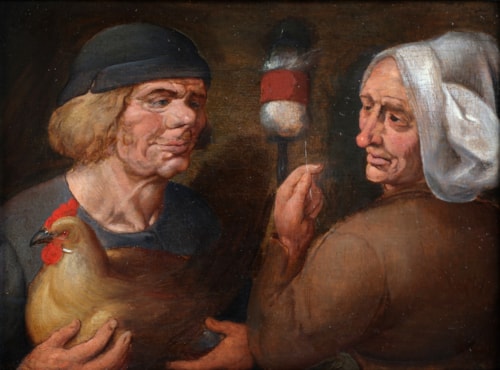
This painting is a fine example of Maarten van Cleve’s ability to capture the rhythms of daily life with immediacy and empathy. The scene presents two figures in a modest rural interior, rendered with the directness and lively characterisation typical of his mature work.
On the left, a woman is shown spinning wool. She holds a distaff with uncarded fibres, her posture focused yet relaxed. Van Cleve’s attention to the gesture of her hands, the texture of the wool, and the weight of her clothing reflects his interest in depicting traditional domestic labour with clarity and respect.
To her right stands a man holding a chicken firmly but without aggression. The bird is painted with striking naturalism, its feathers and form carefully observed. The man appears caught in the midst of a task, lending the composition a subtle narrative tension — a hallmark of Van Cleve’s genre scenes, where everyday actions become moments of quiet storytelling.
The dark background isolates the figures and heightens their presence, while the warm palette and volumetric modelling are characteristic of Van Cleve’s work from the 1560s–1570s.
The painting’s intimacy and focus on simple human activity distinguish it from his larger festive or outdoor scenes, offering instead a close, almost tactile glimpse into rural life.
This work exemplifies Van Cleve’s mastery in portraying ordinary people with dignity, humour, and painterly vitality.
16th century
+32 (0)478 38 18 29
RELATED WORKS
YOU MAY ALSO LIKE